Aspire Advocates for behavioral health
public notice no. 1
the missing codes campaign

Behavioral Health Care
Have you seen this life saving care?
Last seen
In a benefits summary. In a directory listing. In a phone call that ended with we don’t have anyone taking new patients.
Distinguishing marks
Evidence-based. Recommended by clinicians. Impossible to bill.
Last known price
Cash. Paid in full, up front, a thousand miles from home.
Reward
A permanent, independent federal Behavioral Health Coding Council — with seats for the people who live with the consequences.
Sworn testimony of one family
“In 2025, after weeks of calling every facility my insurance gave me, I wrote a check for sixty thousand dollars to a treatment center a thousand miles from home. There was nothing my insurance would cover anywhere in the country. I came home better. Not because the system worked. Because I could pay.“
Kelli Unnerstall • Cash Pay
For too many behavioral health services, the billing codes are missing — or the codes that exist don’t adequately cover the service. No code, no payment. No payment, no program. What is left is a shortage, or a cash price.
The result of Missing Codes is Missing Care.
Part I • The Missing Care
Sometimes the care is out there. Finding it takes a search party.
Sometimes the care does not exist near you. Sometimes it exists but no one in network provides it. Sometimes it exists, in network, and still cannot be delivered the way the research says it works. Too often, care that is missing or out of network is out of reach because of a medical billing code. No code means no care. What follows is a shortage, or a cash price.
Reported missing
status as of this notice
Dialectical Behavior Therapy (DBT)
Not fully covered
Extended therapy sessions
Pushed into cash pay
Residential psychiatric care
Out of network
Long-term psychiatric care
Dismantled
Recovery high schools
Missing from most communities
Alternative peer groups
Patchwork funding
The Numbers. What access looks like now.
3.5x
More likely to go out-of-network for behavioral health care.
RTI International · 2024 1
10.1x
More likely for children’s behavioral health visits to be out-of-network.
Milliman Research Report · 2019 2
18%
Only 18% of calls to listed mental health providers resulted in an appointment.
U.S. Senate Committee on Finance · 2023 3
45%
Nearly half of psychiatrists did not accept private insurance.
Bishop et al. · JAMA Psychiatry · 2014 · baseline 4
Long-Term Psychiatric Capacity
The country dismantled long-term psychiatric capacity without building an adequate replacement. “The state hospitals were overcrowded, understaffed, and in too many cases unconscionable. But the answer to bad institutions was never no institutions. It was better institutions. We were supposed to reform the continuum of care. Instead, we amputated it.” — Cash Pay • Chapter One
560,000
People in state psychiatric hospitals · 1955 peak
36,150
State psychiatric hospital beds · 2023 8
The treatment can exist. The science can be solid. People can be dying. And still, without a billing code, the door stays closed.
Part II • The Missing Codes
At the heart of America’s failing behavioral health system is a crisis in billing codes. A treatment can be proven to work and still be impossible to bill.
Who controls billing codes?
The American Medical Association — a private trade association — owns and maintains CPT, the billing code set used across American health care.5 Its CPT Editorial Panel has 21 seats. There are no lived-experience seats. Behavioral-health professionals have limited representation in the process.6
What was taken away
On January 1, 2023, the AMA deleted the codes that paid for extended psychotherapy sessions. There is now no CPT code for a psychotherapy session longer than sixty minutes. A sixty-minute talk therapy session and a ninety-minute EMDR intensive bill at the same rate.
What the ledger shows
The 2026 code set added 288 new codes. Forty-six of them updated a single leg surgery. Behavioral health got nothing.
What a missing code looks like · DBT 7
Individual therapy
PAYABLE
Skills group
incomplete Code
Phone coaching between sessions
No reimbursable Code
Therapist consultation team
No reimbursable Code
4
Parts required for the treatment
1
That insurance reliably pays for
No code, no payment. The wrong code, the wrong payment.
She gives me ninety minutes. She gets paid for sixty.
the solution
Establish a permanent, independent, federal
Behavioral Health
Coding Council.
1
Mandatory statutory seats for people with lived experience.
2
Mandatory seats for the behavioral-health professionals who deliver the care.
3
Consultation authority over behavioral-health coding decisions.
4
Authorized to recommend new and revised behavioral-health codes.
5
Requires a federal response from CMS and HHS.
Nothing about behavioral health billing without us.
Why I am asking
This is personal.
“I have lived with bipolar disorder since I was thirty. I am well today because my family could pay cash for the care that insurance would not cover. That is not a health care system. That is a price of admission. In no other area of medicine has a two-word phrase — cash pay — become the dividing line between recovery and ruin.”
– Kelli Unnerstall • Author of Cash Pay • Founder, Aspire Advocates
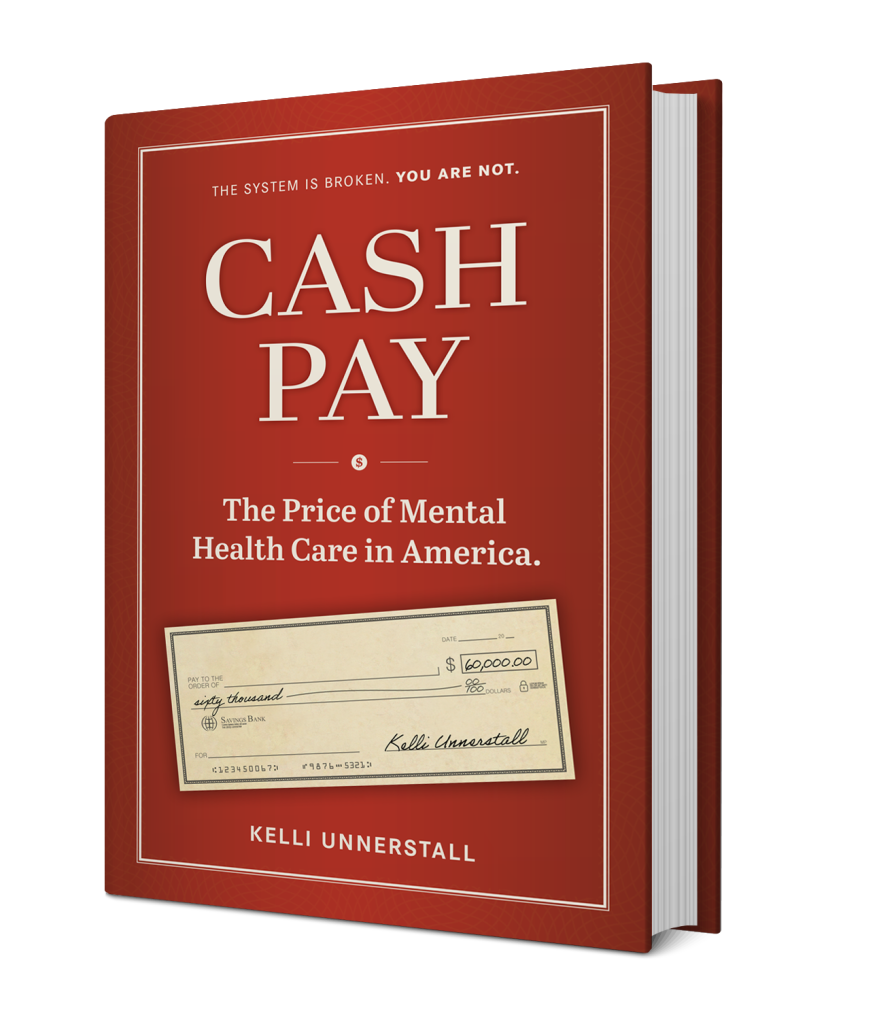
Cash Pay is not a billing code. It is a sorting mechanism — the line that divides who gets treatment and who is abandoned. It is the answer to every question a desperate family asks. Can my son get into this program? Can my daughter stay long enough to stabilize? Is there a bed available? The answer is always the same. How much can you pay?
I wrote Cash Pay because I am the proof. The book publishes soon; this campaign begins in its final chapter.
search parties forming
Join the search.
Cash Pay publishes soon. The campaign in its final chapter starts now — three things.
1
Not a follower. Not a name on a mailing list. A member — members are who legislators count. No dues, no fees.
2
Sign the petition.
Coming soon!
3
Post it where families and lawmakers will see it.
THE RECORD
- RTI International, 2024. Behavioral Health Parity — Pervasive Disparities in Access to In-Network Care Continue (Mark & Parish; 22.8M enrollees, 2019–2021 claims). rti.org
- Milliman Research Report, 2019. Widening disparities in network use and provider reimbursement. milliman.com
- U.S. Senate Committee on Finance, 2023. Ghost networks secret shopper study. finance.senate.gov
- Bishop et al., JAMA Psychiatry, 2014. Baseline figure; not updated since publication. jamanetwork.com
- Treatment Advocacy Center, 2016. Psychiatric Bed Supply Need Per Capita — 1955 peak resident census. tac.org
- Treatment Advocacy Center, 2024. Prevention Over Punishment — 36,150 state psychiatric beds. tac.org
- American Medical Association — CPT code set basics and resources (more than 11,520 codes in the 2026 set). ama-assn.org
- Sen. Bill Cassidy, M.D., Chairman, U.S. Senate Committee on Health, Education, Labor & Pensions, October 6, 2025. Letter to the American Medical Association. help.senate.gov
- American Medical Association — the CPT Editorial Panel and its seat composition. ama-assn.org
- American Medical Association, CPT 2023 code set — prolonged services codes 99354 and 99355 deleted effective January 1, 2023. ama-assn.org
- American Medical Association, Behavioral Health Coding Guide, updated March 7, 2025. Count is of codes dedicated to behavioral health — the CPT Psychiatry section (90785–90899) plus psychiatric collaborative care management; it excludes testing, health-behavior, and E/M codes shared with other specialties. ama-assn.org
- American Medical Association, September 11, 2025. “AMA Releases CPT 2026 Code Set” — 288 new codes, 46 for leg revascularization; behavioral health received only the addition of existing codes to the telehealth appendices. ama-assn.org
- DBT-Linehan Board of Certification — the four components of adherent DBT. dbt-lbc.org
- DeCou, Comtois & Landes, Behavior Therapy, 2019; Storebø et al., Cochrane Database, 2020 — DBT efficacy for suicidal behavior. cochranelibrary.com
- American Medical Association, 2023 Annual Report — CPT royalties of approx. $285M, about 61% of total revenue. ama-assn.org